For a lot of people, much of the struggle lies with what to actually do in the gym to build muscle, while hitting every muscle group properly. The first important thing to be aware of are the muscle groups in the upper body. These are: the chest, the back, the biceps, the triceps, and the shoulders (deltoids). Each of these come with parts to them (different heads or even muscles).
Ideally, one should aim to hit every muscle group twice a week for the most amount of muscle growth but with busy schedules this may be hard to achieve. This is where one must pick a split. A split is just a schedule of which days you work out and what’s done on those days.
Picking a Split
Pick a split based on days per week and time per session. Picking a good split will help manage recovery and frequency (the number of times you hit a muscle group). As has been mentioned, a 2x frequency (every muscle group twice a week) is the most optimal and relatively easy to achieve however working a muscle group once a week will grow muscle just fine.
Some of the most popular splits are:
PPL (Push – Pull – Legs)
Legs are self explanatory (and will be covered in another article) but upper body movements can be broadly split into pushing and pulling movements. Push exercises utilize muscles that help push the weight away from your body (the chest, shoulders, and triceps) while pull exercises focus on muscles bringing the weight towards your body (back and biceps). PPL is most commonly done twice a week as Push – Pull – Legs – Rest – Push – Pull – Legs but it can just as easily be done once a week.
Arnold Split
The Arnold split also has 3 different days worth of exercises but instead of splitting the upper body based on pushing and pulling movements it splits it based on arms & shoulders and then chest & back. The three days are Chest & Back, Arms & Shoulders, Legs. When doing this, the chest and back day is typically done before the arm day as your biceps and triceps are active when working out your chest and back, making them too fatigued before your actual arm day. This can also be done with a 1x or 2x frequency.
UL (Upper – Lower)
This involves training your entire upper body on one day and then your legs on another and is typically done with 2x frequency as Upper – Lower – Rest – Upper – Lower – Rest – Rest. While this achieves 2x frequency with only 4 days in the gym the full upper days tend to take longer than a push, pull or Arnold day would. This means longer times in the gym, which may not be ideal for some people
PPL x UL
This is a combination of Push Pull Legs and Upper Lower which achieves 2x frequency with only 5 days in the gym as opposed to 6 with normal PPL. This would only have one time consuming upper day as opposed to the 2 had with UL.
Which one should I choose?
Choosing which split is best ultimately comes down to personal preference as all of them are solid and lend to their own advantages and disadvantages.
Muscle groups and exercise selection
The following section will go over each of the muscle groups along with which exercises best target those muscles. I will put an asterisk (*) next to the specific exercises that I prefer.
Chest
The chest (pectoralis major) is made up of two parts, the mid/lower chest (sternocostal head) and the upper chest (clavicular head). Simply put, the chest can fully be trained in 2 exercises, one for each head.
The sternocostal head makes up the majority of the chest (80% of its total mass) and performs the function of horizontal shoulder adduction, bringing the upper arm in towards the body horizontally. This can be trained with a variety of exercises a few of which are
- Flat barbell bench press*
- Flat dumbbell bench press
- Chest flys / pec deck*
When flat is said here it means the level of incline of the bench.
The clavicular head makes the up the rest of the chest mass and gives a fuller look to the chest overall. In addition to performing the function of shoulder adduction the upper chest performs shoulder flexion. In simple terms, the function of the upper chest is to bring the upper arm up and in. This means that in pressing movements it is best to always keep the elbows tucked in towards the body to fully perform the function as best as possible. Some exercises for the upper chest are
- Incline barbell bench press
- Incline dumbbell bench press*
- Low to high cable fly
Here an incline on the bench means anywhere from 15 to 35 degrees. Any more than that and then the bulk of the tension will be placed on your shoulders.
A tip for selecting exercises for chest is to pick one press and one fly.
Triceps
The triceps (triceps brachii) have 3 heads (hence the prefix tri-), the long head, the lateral head, and the medial head. The triceps can be properly targeted in 2 exercises, one for the long head and one for the lateral and medial heads.
All of the heads of the tricep perform elbow extension so with every tricep exercise every head will get worked meaning it is not possible to completely isolate heads. However, it is possible to bias them. Exercises that bias the long head are those where the upper arm stays in place while exercises with the upper arm moving more effectively target the lateral and medial heads. Some long head exercises are
- Single arm tricep extension*
- Rope tricep extension
- Overhead tricep extension
- Skullcrusher
Some lateral and medial head exercises are
- Tricep pushdown (either with a straight bar or a V-bar)*
- Bodyweight, weighted or machine dips
- JM Press (between a close grip bench press and a skullcrusher)
My personal favorites here are a single arm extension paired with a straight bar pushdown.
Biceps & Forearms
The biceps (biceps brachii) are the simplest muscle to work out because they only have one function: elbow flexion, or bringing the forearm closer to the upper arm. This means that any type of bicep curl will effectively work the bicep well enough. However, not all curls are created equal. Certain exercises like the preacher curl * have peak tension on the bicep in the lengthened position, where it has more leverage, which some studies have shown to cause more growth. Overall any curl will work capably to grow the bicep and examples are
- Dumbell bicep curl
- Preacher curl
- Barbell / EZ bar curl
- Bayesian cable curl
My go-to for biceps is the preacher curl.
The main part to work on for the forearms is the brachioradialis. For this it is just best to just do a reverse curl with an EZ bar, which is just a bicep curl with your palms facing away from your body.
Shoulders
The shoulders muscles (deltoids) are split into three heads, the anterior deltoid (front delt), the lateral deltoid (side delt), and the posterior deltoid (rear delt).
The front delt performs shoulder flexion, meaning it serves to bring your upper arm upwards. The front delts already get worked with compound pressing movements that target the chest but it is still a good idea to do a movement that focuses on the shoulder specifically. This is best trained with a shoulder press.
The side delt performs shoulder abduction, which put simply means it lifts your arm out to the side, away from your body. You can train this with some variation of a lateral raise, either dumbbell or cable.
The rear delt also moves your arm away from your body but it does so towards your back and horizontally. Your rear delts are worked well enough with any upper back row as the arm path remains the same however many people still opt to do a rear delt isolation such as a rear delt fly or face pulls.
For shoulders I tend to do just a cable lateral raise and a dumbbell shoulder press.
Back
Back training comes down to picking 3 exercises, one to train in each anatomical plane.
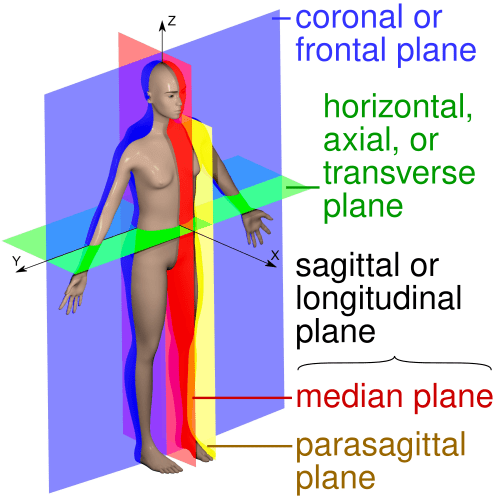
The back consists of 3 planes which are
- The frontal plane (blue) that is vertical and runs parallel to your body
- The sagittal plane (red) that is vertical and runs perpendicular to your body
- The transverse plane (green) that is horizontal
The back muscles are made up of your upper back, which is your trapezius (traps) and rhomboids, and your lats (latissimus dorsi). The fibers in the lats themselves are split into the upper and lower lats. While the parts of the lats cannot be completely targeted separately it is believed that one can bias the upper and lower parts.
The upper back is trained with a transverse plane movement such as
- Wide grip row*
- T-bar row
- Bent over row
The main focus when training upper back is scapular retraction, which is bringing your shoulder blades together. All of those rows will also work your rear delts and biceps but your upper back can be isolated with a move like Kelso shrugs.
Your upper lats are biased with a sagittal plane movement like a
- Close grip row*
- Close grip lat pulldown
The lower lats are trained with a frontal plane movement, the best option of which is a wide grip lat pulldown* or possibly just wide grip pullups.
My back routine is a wide grip cable row, a close grip cable row and a wide grip lat pulldown.
Reps and Progression
While this is a concept that deserves an article in its own right the simple rule is to a pick a rep range and progressively overload. For example, say that you do your bench press with a 6-8 rep range. This means that you perform as many reps as possible and as soon as that number exceeds 8, you increase the weight, bringing you back down to around 6. Popular rep ranges are 6-8 and 8-12 but truly anything will be okay as long as you are training to near failure.
In terms of the number of sets you do it should from 2 to 3 based on personal preference and your ability to recover.
Conclusion
Upper body training works best when you keep it simple and repeatable. First, pick a split that fits your schedule and lets you recover. Then pick a small set of exercises that cover each major muscle group: chest, back, shoulders, biceps, and triceps and stick to them. Constantly switching out exercises requires you to relearn form which could hinder your ability to overload. You do not need every variation. When reaching the top of the rep range progressively overload by increasing the weight. If these things are done consistently, one will build strength and muscle over time.

 Plates & Plates
Leave a comment